 |
An Interview with William Whittaker
by
Denise Soussi
December 2006
Earlier this year, I had the pleasure of meeting an elderly gentleman through work, who mentioned that he had grown up in and around Chapel Lane. He told me he was 86 and asked me if I knew a place called the Wilmslow Green Room. As it happened, of course, I did! He told me he thought he had been born there, and I had a wonderful image in mind of him as a baby in the room which is now our props cupboard. When he then added that he had never been into the Theatre, I suggested we meet up there one Saturday morning so that he could have a look.
As it turned out, when Mr Whittaker did visit, he brought a photo with him showing his mother, Mary, and her friend Maude Allmark at the garden gate of their house (taken sometime in the late 1920s).
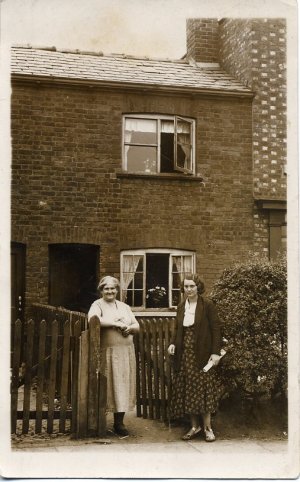
This and Bill’s chats to his family before his visit revealed that the family home was in fact the cottage next to the Green Room entrance area, eventually bought by the theatre and then sold on to Jones to enable them to expand their plumbers’ showroom. Also, that Bill’s grandmother had been the actual owner of the cottage (then numbered as 37 Chapel Lane), until she died in 1926 and his mother and father moved back in. Bill actually thought of it as home, he says, as he spent a lot of time with his grandmother, Elizabeth Whittaker, and from there went off to Infant School in Nursery Lane.
The two cottages were quite similar in size, though perhaps different in layout. The stairs that go up from the lower foyer of the Green Room are on the end wall; Bill thinks their stairs went up inside the front door. But both were basic two-up, two-down houses with stone floors and a step down from the ground floor front room to the kitchen; this back room was equipped with a shallow brown sink and cold tap. He thought that his house had had gas mantles, and recalled the small yards and gardens that had been behind the cottages, each with its outside lavatory. You can still work out the size of the cottages from the point where the bar and coffee area are built on to the back of what is now number 85 Chapel Lane.
His Mum slept downstairs, he says, as ‘her legs were bad’. He thinks she had dropsy. Brother Gordon had the back bedroom; Mr Whittaker and his sister Joyce shared the front one. Had Bill had looked out the bedroom window then, he pointed out that the view across the road would have been very different indeed from what it is now – as Buckingham Road did not exist at that time. A large gate and open fields were opposite, and the road itself was a quiet thoroughfare for carts. The occasional car was a strange sight indeed! However, one high point of the year was the annual Carnival procession which went right past the front on its way from the Carnival Field, down Oak Lane and along Chapel Lane on its way into the village. People would stand at their doors to watch and marvel at the floats put in by local businesses.
As a young lad Bill says he ran errands for the confectioner, Mr ‘Chummy’ Coburn, whose shop was where the Chocolate Whirl now is. He remembers Mr Coburn’s habit of hymn singing, and that Mrs Coburn would give him an occasional cake for free. He also recalls the girls who used to go to work in the factory behind the cottages, accessed down the path at the side of the theatre – ten or a dozen girls, arms linked, going in to what he thought was a laundry (in fact a shirt factory trading under the name, Longdura). [The archive photo from 1989 shows the cottage and path.]
When Bill was 15 the family moved to a house on Moor Lane, by which time he was an apprentice decorator with Broadhurst’s on Hawthorn Street, and aged 19 he was called up and went into the navy, serving as an engineer (for a time on the same ship as Prince Phillip). The young lady he married when he returned to Wilmslow sadly died earlier this year, but Mr Whittaker still lives close by and is enjoying gathering up his memories of childhood.
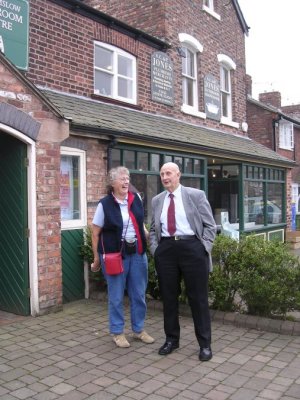
Mr Whittaker with Jacque Bilsborough
|
|
